
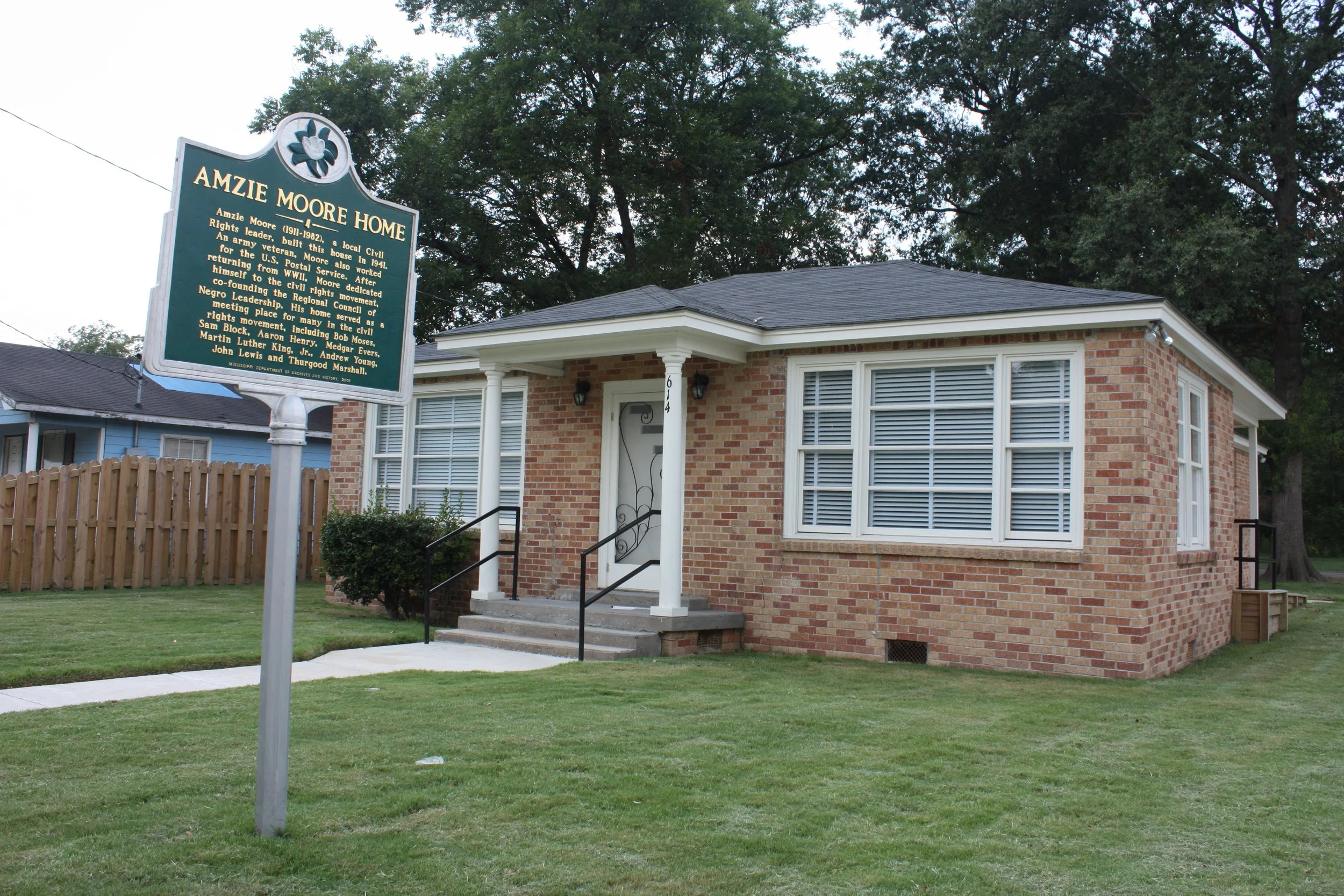
Social Infrastructure: The Enduring Legacy of Amzie Moore
By Anna Marie Hanna
Amzie Moore's dedication to addressing racial injustices helped spur activism in the Mississippi Delta decades before the Civil Rights Movement. Moore was born on Wilkin Plantation in Grenada County in 1911 to Black sharecroppers. After his mother died when he was 14 years old, the teenager picked cotton in Drew. Moore graduated from Stone Street High School in Greenwood in the 10th grade, the highest offered at the school, and earned wages as a young man by taking on odd jobs at hotels, cafés, and the local cotton gin.
"Moore is particularly significant when we speak of civil rights leaders, especially the most notable ones in the 1960s," Delta State University Director of Archives, Assistant Professor, and Mississippian Charles T. Salazar said. "Many of the leaders and organizers we know in the history books have birth years in the 1940s, and Moore was already conducting important work by the 1930s."
In 1935, Moore moved to Bolivar County and took a federal post office custodian job, a position rarely offered to Black people at that time. Limited to voting in general elections, he joined civic groups like the Black and Tan Party. Drafted in 1942, his experience with segregation in U.S. Army camps during World War II fueled his commitment to Black rights. While abroad, he joined the NAACP, defining his legacy in the fight for Black prosperity.
In the early 1940s, Moore and his wife, Ruth Carey, bought a modest home with the first FHA loan issued to an African American in Bolivar County. In the 1950s, he opened a service station and café in Cleveland, refusing to use segregated restroom signs. Despite death threats for his activism, he continued working for the postal service, running businesses, and recruiting for the NAACP. In 1955, Moore became the first president of Cleveland's NAACP chapter, growing it to 439 members.
"Moore's end game wasn't Black people having the right to vote," Salazar said. "It went so much deeper because he understood that you had to fight to change the structural location of Black residents in Mississippi, at this intersection of capitalist exploitation and racism, and take as many concrete steps as possible to change the material reality of his community." This quote doesn’t make sense to me.
Within Moore's house, civil rights leaders like Martin Luther King Jr., Medgar Evers, Fannie Lou Hamer, and Student Nonviolent Coordinating Committee (SNCC) members found sanctuary during voter registration drives and Freedom Summer of 1964. "Moore recognized his place in the movement was to sustain the created civil rights space and connect movers and shakers into the network already alive on the ground," Salazar said.
In 1955, Moore helped to lead the search for the body of Emmett Till, which brought attention to the murders of Black Mississippians. Disillusioned with the NAACP's approach, Moore focused on building SNCC, collaborating with Bob Moses on voter registration drives, starting Head Start programs, and supporting the National Council of Negro Women. He also served as the first chair of the Mississippi Action Committee on Education from 1967 to 1970.
After sitting vacant and deteriorating for years, the Amzie Moore House was listed by the Mississippi Heritage Trust as one of the state’s 10 Most Endangered Historic Places in 2011. The Bolivar County Board of Supervisors spearheaded a strong local coalition to secure funding from the Mississippi Department of Archives and History Community Heritage Preservation Grant Program to save the house. 1n 2015, Belinda Stewart Architects, PA oversaw the extensive restoration.
Now under the care of Delta State University, the Amzie Moore House is a museum and interpretive center dedicated to telling the story of one man’s fight for civil rights. Salazar said Delta State has plans to expand the educational mission of the museum. “We aim to use Amzie Moore's house to sow the seeds of his model of education and having a community gathering place.” Partnering with the Freedom Project Network, Delta State has hosted programs by civil rights scholars at the house that focus on the “hyper locality” of the movement in the Delta.
"Moore knew his place wasn't to lead at the front, but to lead the charge from behind," Salazar said. Moore's efforts built a foundation for the efforts of countless activists and reformers. "The Mississippi he was born into in 1911 versus the Mississippi he died in in 1982 is radically different because of his work.”
To learn more about the Amzie Moore House and to schedule a tour, visit deltastate.edu/library/departments/archives-museum. The Mississippi Encyclopedia, The Bolivar Bullet, and The Society of Architectural Historians provided additional research for this article.