
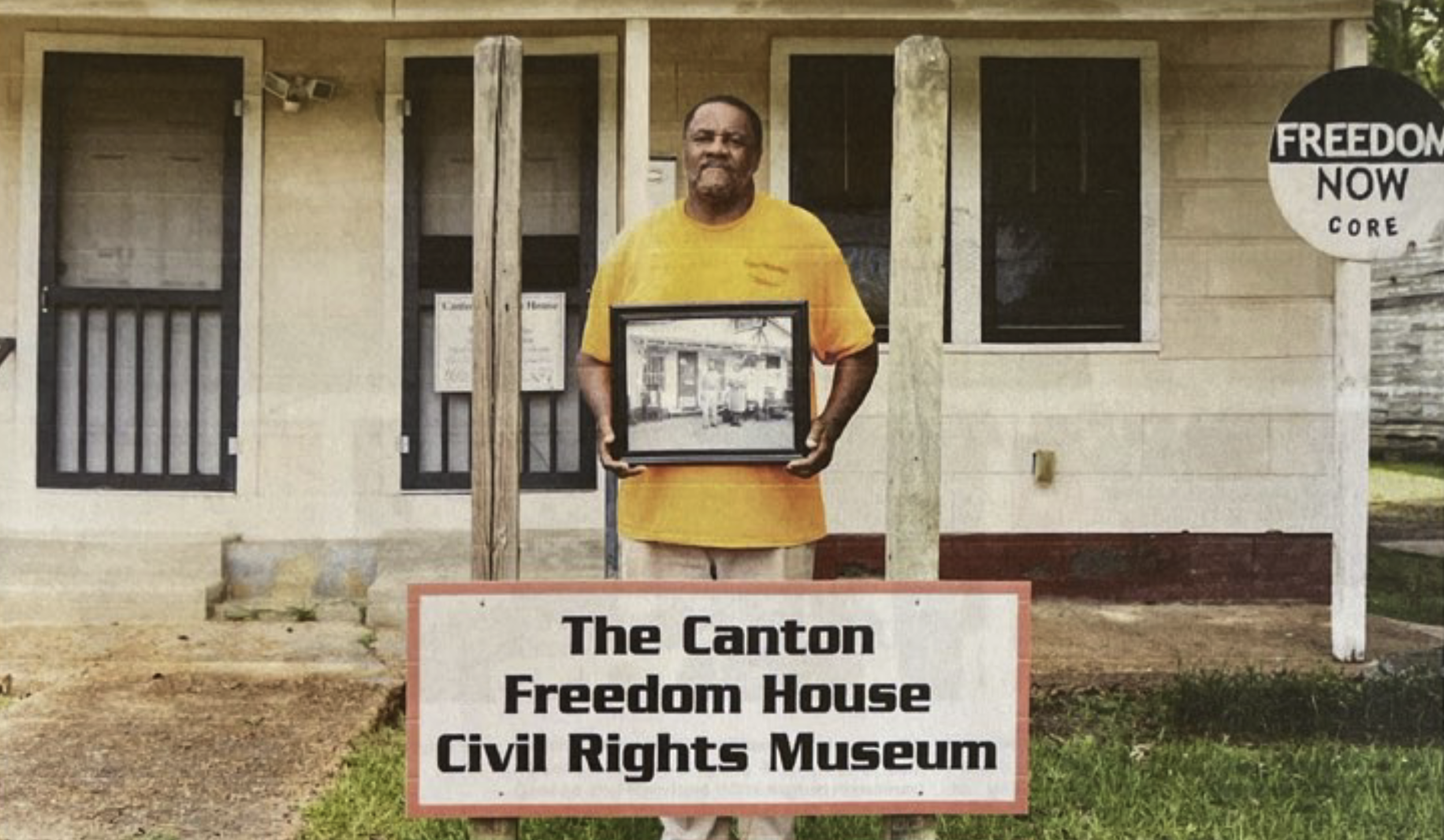
A Family Legacy-The Canton Freedom House Civil Rights Museum
By Erin McKewen
In 2012, Glen Cotton was faced with an ultimatum from the City of Canton: tear down the abandoned family property at 838 George Washington Avenue or restore it. For some people, the choice would have been demolition, but for Cotton the history of the house made that impossible. He knew in his heart he had to save it.
George and Rembert Washington, Cotton’s grandparents, were successful business owners and prominent figures in their community. They owned the George Washington Grocery, as well as the family home next door and two rental houses across the street. In 1963, when George Raymond, a young African American civil rights activist from New Orleans, came to Canton to organize voter registration through Congress of Racial Equality (CORE), the Student Nonviolent Coordinating Committee (SNCC), and the National Association for the Advancement of Colored People (NAACP), he needed a safe place to stay and turned to the Washingtons. 838 George Washington Avenue then became a place of refuge for civil rights workers.
Originally intended to be a place for Raymond and other traveling volunteers to sleep, the house soon became much more - a meeting place, printing and dispatch center, and community hub. The Washingtons opened their home and rental houses to many activists over the years, including Dr. Martin Luther King, Jr., James Meredith, and writer Ann Moody. They knew the risks they were taking to support the movement and the young volunteers that passed through Canton and they did so willingly.
The support of the Washingtons didn’t go unnoticed by those opposed to the movement. Due to intimidation and fear, vendors began to cut off supplies to the grocery, the gas pumps were removed, and the mailbox was even taken away. Community members helped stock the store when vendors refused to make deliveries, usually a carload at a time. An attempt to destroy the Freedom House with a bomb was unsuccessful. In the face of it all, George and Rembert Washington remained steadfast in their conviction and dedication to the movement, the volunteers, and the community that relied on them.
Today, all that remains of the neighborhood grocery store is a low brick wall. The house across the street, however, has been lovingly transformed into the Canton Freedom House Civil Rights Museum. Cotton, who is a carpenter and builder by trade, spent years restoring the house. Used as a rental property for decades before falling into disrepair, the house required considerable work before the dream of a museum became a reality. “I had thought about preserving it, but that whole process was new to me. I didn’t know how to start. But what I did know was that I wanted to save this house. I knew it had history.”
Cotton replaced the damaged wooden floors and roof, as well as removed old sheetrock and lined the interior walls with plywood. The windows are original to the house but are sealed off from the interior to provide better security. Cotton says, “Preserving the historical value makes it all worth it. My grandparents contributed a lot to the movement here in Canton, and this is for their memories’ sake.”
Now, photographs, letters, and memorabilia line the walls of each room. Maps show safe places for activists to turn to for help when out in the field. A payphone hangs in the corner, representing the one installed by George in 1963 for communication between activist groups, organizers, and family members. Chicken wire has been stapled to the exterior of the windows, as it was during the civil rights movement in order to keep out Molotov cocktails.
Cotton has found himself the keeper of the stories of the Canton movement. “Every now and then someone will bring me a picture or artifact or something and then they're telling me about it. About their connection to the house and to the movement.” Names from across the country, and even those from other countries, have filled the pages of the visitor register of the Canton Freedom House Civil Rights Museum. With plans to retire next year, Cotton plans to turn his full attention to the museum, including the erection of an official Mississippi Freedom Trail marker.
The Canton Freedom House Civil Rights Museum currently relies solely on donations, as Cotton does not charge an entry fee. To donate to the Canton Freedom House Civil Rights Museum and the work of Mr. Cotton, you can do so in person or through _____ (getting venmo or cashapp set up). You can also visit the website at: https://freedomhousecanton.org/ for information on hours of operation and ways to get in touch.
If you would like to read more about the Canton Freedom House and the members of the Canton Movement, Ann Moody’s book ‘Coming of Age in Mississippi,’ is an excellent resource.