
Inheritance
The Legacy of a Movement
By Amanda Wells
“Every generation leaves behind a legacy. What that legacy will be is determined by the people of that generation. What legacy do you want to leave behind?”
— John Lewis
The human condition consists of unknowingly crafting our stories, full of seemingly small things that come together in the end to serve as collective memory. For a handful of Mississippi souls, the modest homes they left behind were much more than simply shelter. These houses served as places where the future was shaped through the courageous efforts of local activists along with Civil Rights workers who came to Mississippi as part of Freedom Summer in 1964.
The owners of these unassuming houses were not only brave, but fed up. Despite the threat to their properties, their livelihoods and their lives, they fought for social justice and provided the foundation on which the Civil Rights movement would grow.
On June 15, 1964, the first 300 volunteers from around the country, both black and white, arrived in Mississippi for Freedom Summer with Project Director Bob Moses at the helm. On a mission to register and empower Black voters, the group waded into dangerous waters. Indeed a brutal history unfolded that summer including the tragic deaths of Michael Schwerner, Andrew Goodman, and James Chaney. Houses, businesses, and churches were bombed and burned. Mississippi put its racial reckoning on display for all the world to see, a reckoning that would shape generations to come.
While news coverage showed the grim reality of what was playing out in the streets of small towns throughout the state, tucked behind closed doors were the brave Mississippi men and women who welcomed the movement into the most sacred of spaces – their homes. These “Freedom Houses” provided a place of refuge where activists could retreat and recover from the daily stresses of Freedom Summer. Most Freedom Houses were in undisclosed locations, kept secret for security reasons. Freedom Summer volunteer Fred Bright Winn recalled that one of the most difficult and necessary things in organizing a community was securing a place for volunteers to live. “People were so afraid – and justifiably so – to let a Civil Rights worker into their home,” he said. “It could mean the loss of a job, a beating or the bombing of one’s home.” While some places like the Amzie Moore House in Cleveland and the Canton Freedom House have been restored to tell the nationally-significant story of Mississippi’s fight for Civil Rights, many of these houses are being lost to time.
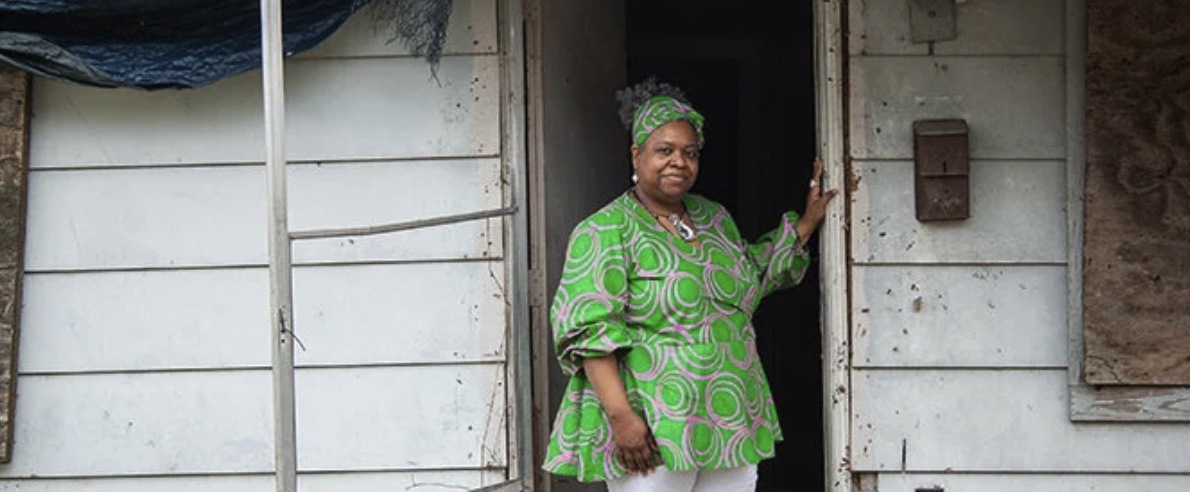
For Dr. Felicia King, the Civil Rights legacy that was a gift from her grandfather includes a Freedom House. When King recently inherited a family property in Indianola, she soon learned of the structure’s Civil Rights history. After the Mississippi Freedom Democratic Party’s (MFDP) House in Indianola was bombed, King’s grandfather Estell “Tide” King stepped forward to rent a house to the Civil Rights workers. Here, they found a safe place to sleep, keep records and organize the day-to-day operations of registering voters. Today, the home is in poor condition, but King won’t give up on preserving this important tie to her grandfather’s legacy. “Everybody was scared to step up, and he did,” she says. “It was a risk. The place had to be guarded constantly and there were lives at stake. It’s important to tell that story.” King finds herself fighting an uphill battle, but has worked hard to stabilize the house. “I want to do all I can to save the house,” says King. “I’m not sure what the future will hold for it, but I am doing all I can to make sure it doesn’t just completely fall in.”
In McComb, which became known as the “bombing capital of the world” during Freedom Summer, Judith Roberts’ grandfather Curtis Conway “C.C.” Bryant was a stalwart advocate for Civil Rights. He served as the National Association for Advancement of Colored People (NAACP) branch president from 1954 until 1984.
Like many in the movement, Bryant was a small-town man that had simply had enough. He was employed with the Illinois Central Railroad as a crane operator and as a licensed barber, operating his own barber shop next door to his home on the weekends.
“He took the position with the NAACP because no one else would take it,” says Roberts. “He decided it was the right thing to do because of the abuse he witnessed daily. Coming home one day from church, he witnessed police officers brutally beating a disabled black man. My grandfather told them to stop and they said, ‘move on, or we will do this to you.’ He stood up to them and didn’t back down.” While Bryant was left unharmed, a spark ignited in him.
Bryant kept African American publications in his barber shop to keep his customers, friends and network informed. “Black press connected and shared information throughout the country at the time,” says Roberts. “He had copies of Jet, Ebony, The Chicago Defender, among others. It became a hub of sorts, a free Black space.” That gruesome summer, Bryant’s barber shop was bombed and lost, making it one of 24 bombings that wreaked havoc on McComb.
Bryant’s home next door was where he shared meals with his friends Medgar Evers and Bob Moses and provided a safe haven for those vulnerable due to their stand for Civil Rights. “My grandmother Emogene saw the house as her home, not C.C. Bryant’s display case,” remembers Roberts. His numerous awards and artifacts were stored in “the junk house” out back, which was later destroyed in a fire. Now, the C.C. Bryant House sits empty and in need of major work. “My father helped rebuild the home about 20 years ago. Now, the roof is damaged and the house is in dire need of repairs.”
Roberts looks forward to restoring the C.C. Bryant House to become a resource for the community that it has long served. “When I think back on my grandfather’s legacy, this entire community was such a huge part of his story,” she says. “I have plans and lots of support for this vision for the house. I’ve talked to Bob Moses, who is committed to the work of continuing my grandfather’s legacy. We are not going to let this die.”